 Assignment #19: Comparing Two Places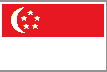
 Singapore and Brunei: the Tiny Dragons
by Tim Newfields
Assignment #19: Comparing Two Places
Singapore and Brunei: the Tiny DragonsSingapore and Brunei are tiny nations in southeast Asia whose economic significance far exceeds their size. Both of these affluent former British colonies share a number of intriguing similarities, yet they also differ in many ways.
Singapore: A City-State Which Runs Like a Clock
Singapore is located off the tip of the Malay Peninsula, at a point where the Strait of Malacca and South China Sea merge. Its strategic location along major shipping routes hastened its development. Singapore consists of one small island and about 50 even smaller islets. The City of Singapore takes up about 30% of the land on the main island, which is connected to the Malaysian mainland by a bridge.
Singapore's modern history dates from 1819, when the British established a trading post there. It was a British colony from 1867 until captured by the Japanese in 1942. Following World War II Singapore became a semi-autonomous member of the British Commonwealth, then briefly a state within Malaysia. Tension with Malaysia escalated and in 1965 it broke away to become independent. Today Singapore is a carefully managed city-state. It has excellent international trading links and a strong economy. However, rising labor costs and the high value of its currency challenge its long-term competitiveness.
Brunei: A Kingdom of Gas and Oil
Brunei, a virtual enclave of Malaysia, is located along the northwestern coast of Borneo. Most of it is jungle and only 15% of the country is cultivated. Brunei is divided into two sections by a river basin. About 30 km. of jungle divides the eastern and western parts of the country.
At one time Brunei was the seat of a rich empire stretching across the southern Philippines and all of Borneo. In the 17th Century it was the most powerful Muslim state in Asia. By the 19th Century its power dwindled significantly, and in 1888 became a British protectorate. Oil was discovered along the northern cost of Brunei in 1929. When Malaysia gained independence in 1964, Brunei refused to join the new federation. In 1984 it became fully independent and today is governed by an absolute monarch known as a sultan. No elections are held and no political parties are permitted. Recently Brunei has been moving closer towards Islamic fundamentalism. In 1991 the sale of alcohol was banned and stricter dress codes enforced.
Tourist Attractions
Singapore offers a wide range of attractions for tourists. Many shoppers enjoy visiting Arab Street, Chinatown, and Little India. The Botanical Gardens and Jurong Bird Park have many exotic tropical plants and wildlife. Amusement parks such as the Big Splash feature giant water slides. The main island also has several interesting museums. And Singapore's night life is as lively as that of any world-class city.
Brunei has extensive wildlife, waterfalls, and sandy beaches. Many places are closed during the Moselm holy month of Ramadan, so it is best to visit there other times of the year. The capital, Bandar Seri Begawan, has one of the greatest mosques in Asia. The city also has a couple of excellent museums and zoos. Most places in Brunei have no night life and the streets are empty by 9:00 pm.
Tempting Comparisons
In many ways Brunei resembles the rich oil kingdoms of the Persian Gulf. Its petroleum and natural-gas industries account for 85% of its gross domestic product. Moreover, foreign residents comprise 40% of its labor force. Whereas ethnic Malays who are Muslim receive extensive free services, other ethnic and religious groups are not eligible for many services. This policy of ethnic and religious discrimination, which is also prevalent in Indonesia and Malaysia, contrasts with Singapore.
Singapore is frequently likened to Hong Kong. Both cities are famous as ports and commercial centers. However, there are also significant contrasts. Hong Kong, with a population almost doubling Singapore's, is part of mainland China. The cost of living is lower there than in Singapore. Singapore is also notably cleaner than Hong Kong.
Conclusion
Despite their differences, Singapore and Brunei maintain close economic ties. Much of the petroleum and gas produced in Brunei is refined in Singapore. Singapore also provides a large portion of the hi-tech equipment which propels the Bruneian economy. Brunei's petroleum and natural gas reserves are expected to last another 20-40 years. As long as these reserves flow, economic relations between both counties are likely to remain tight.
References
"Singapore". "Brunei". U.S. Central Intelligence Agency Fact Book. [Online]. Available: www.odci.gov/cia/publications/factbook/. (20 Feb. 1999).
Feld, Lowell. Singapore. United States Energy Information Administration. [Online]. Available: www.eia.doe.gov/emeu/cabs/singapor.html. (Dec. 1998).
Ishii, Shinji. (Ed.) "ASEAN ni Yokosou!". Beyou Takajima Series #56. Tokyo: JICC Shuppan Kyouku. 1992.
Leinbach, Thomas. "Singapore". Compton's Concise Encyclopedia. 1997 Edition. [CD-ROM]. New York: Compton's New Media.
Lonely Planet Guide. "Malaysia, Singapore & Brunei - A Travel Survival Kit". Lonely Planet.
Means, Gordon. "Brunei". 1998 Grolier Multimedia Encyclopedia. [CD-ROM]. Danbury, CT: Grolier Interactive Inc.
- Practical English Writing Homepage -
www.tnewfields.info/write/19SingBru.htm
Copyright (c) 1999, 2002 by Tim Newfields
Updated 23 February 2002