It's the Cracks that Teach:
Some Thoughts about Transience
Now and then I visit Buddhist temples. No priest is usually present, unless a funeral is going on.
Most temple visitors I have observed in Japan consist of elderly
people paying respects at family graves, housewives walking their dogs, or simply tourists coming to relax a few moments.
Generally, thirty-second prayers are offered after tossing a few coins into rusty, locked offertories. To make sure that Buddha is paying attention, some supplicants ring gongs, then bow in silence. Most summer visitors then gently wipe the sweat off their foreheads, fold their handkerchiefs, then slowly head back to their homes.
I've been through this ritual many times. Recently, however, when visiting temples I prefer to "converse" with the trees, rocks, and statues rather than fulfill a set ritual at the main altar . . . often it's a one-way conversation, but at times a sort of "dialog" develops. Trees are patient listeners, and they seem to hear through our thoughts with ease. At the same time, however, it seems many trees stand superbly aloof – to them, all human motion and emotion is simply a whirl of no more significance than a cicada on a leaf.
While priests go about their daily rituals, sometimes I enjoy whatever passes through temple gates. Even better, however, is to sit still and converse with the trees as the wind blows and butterflies dance while birds soar overhead.
At times statues seem to make good conversation partners. You're almost certain to find a capped Buddha or God of Death (Fudō Myō-ō, Búdòng Míngwáng, Caṇḍaroṣaṇa) with upward-pointing sword at most temples in Japan. It is said countless Buddhist deities exist, each with a different countenance. Some are gentle. Others are fierce. All are penetrating in some manner. At some temples, images of distinguished abbots look straight forward, ignoring the visitors whirling by. They never worry about stiff backs, tired shoulders, or insects crawling over their faces.
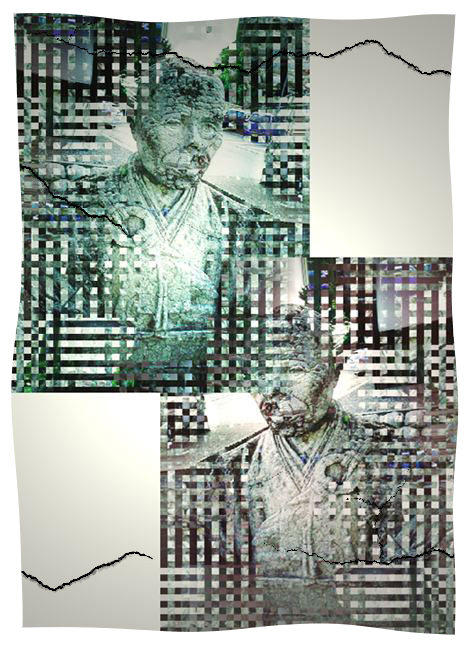
The other day I came across a temple in Hamamatsu, central Japan. It was a small place not far from the main station named "Heart Creation" (Shinzouji) with a curious concrete statue of a monk near its main hall. This statue seemed unusual in several ways. First of all, it was nameless. In fact, I couldn't even tell whether the face was male or female. Moreover, the statue was falling apart . . . that's a good Buddhist teaching.
Examining this statue closely, it seemed both grotesque and fascinating . . . time had worked well on this form. The statue was probably cast shortly after World War II. When I viewed it in the summer of 2006, it had telltale signs of age. Huge cracks stretched across its face and some of its upper lip was missing. The nose was chipped and some of the skull was open. All over the statue, lichen and moss were transforming the stone contortion back to earth.
Despite its dilapidation, this object would probably be around longer than my body, albeit with more cracks and chips. In a few centuries it would no longer be recognizably human - just a lump of concrete crumbling into sand. Since that's how it started out, it seems an apt way of finishing off.
At most temples, I believe the most important teaching is not done by human lips. If you're patient and determined, lessons will come spontaneously just by being in such spaces with a right frame of mind. Sometimes nothing seems to happen: such things are hard to predict. That is a good time to notice the patterns around more closely. And if you happen see a statue with cracks, take a close look . . . those imperfections might have something to teach. Soon enough, all of us will be well-cracked.
I've been through this ritual many times. Recently, however, when visiting temples I prefer to "converse" with the trees, rocks, and statues rather than fulfill a set ritual at the main altar . . . often it's a one-way conversation, but at times a sort of "dialog" develops. Trees are patient listeners, and they seem to hear through our thoughts with ease. At the same time, however, it seems many trees stand superbly aloof – to them, all human motion and emotion is simply a whirl of no more significance than a cicada on a leaf.
While priests go about their daily rituals, sometimes I enjoy whatever passes through temple gates. Even better, however, is to sit still and converse with the trees as the wind blows and butterflies dance while birds soar overhead.
At times statues seem to make good conversation partners. You're almost certain to find a capped Buddha or God of Death (Fudō Myō-ō, Búdòng Míngwáng, Caṇḍaroṣaṇa) with upward-pointing sword at most temples in Japan. It is said countless Buddhist deities exist, each with a different countenance. Some are gentle. Others are fierce. All are penetrating in some manner. At some temples, images of distinguished abbots look straight forward, ignoring the visitors whirling by. They never worry about stiff backs, tired shoulders, or insects crawling over their faces.
The other day I came across a temple in Hamamatsu, central Japan. It was a small place not far from the main station named "Heart Creation" (Shinzouji) with a curious concrete statue of a monk near its main hall. This statue seemed unusual in several ways. First of all, it was nameless. In fact, I couldn't even tell whether the face was male or female. Moreover, the statue was falling apart . . . that's a good Buddhist teaching.
Examining this statue closely, it seemed both grotesque and fascinating . . . time had worked well on this form. The statue was probably cast shortly after World War II. When I viewed it in the summer of 2006, it had telltale signs of age. Huge cracks stretched across its face and some of its upper lip was missing. The nose was chipped and some of the skull was open. All over the statue, lichen and moss were transforming the stone contortion back to earth.
Despite its dilapidation, this object would probably be around longer than my body, albeit with more cracks and chips. In a few centuries it would no longer be recognizably human - just a lump of concrete crumbling into sand. Since that's how it started out, it seems an apt way of finishing off.
At most temples, I believe the most important teaching is not done by human lips. If you're patient and determined, lessons will come spontaneously just by being in such spaces with a right frame of mind. Sometimes nothing seems to happen: such things are hard to predict. That is a good time to notice the patterns around more closely. And if you happen see a statue with cracks, take a close look . . . those imperfections might have something to teach. Soon enough, all of us will be well-cracked.